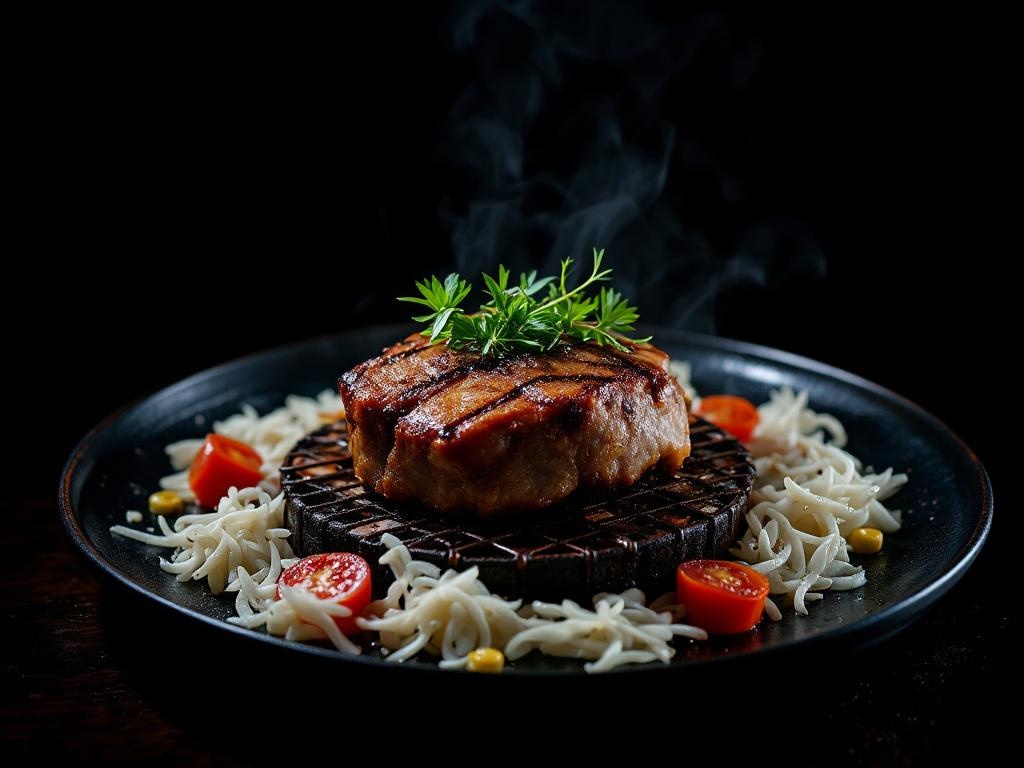
Jingisukan — named after Genghis Khan and reflecting a romanticised Japanese imagining of Mongolian steppe barbecue — is Hokkaido's beloved lamb and mutton grilling tradition, distinctive enough to constitute a regional cuisine unto itself. It is cooked on a domed cast-iron grill (the 'Genghis Khan' pan) that allows lamb fat to render from the convex centre, flow down the slopes, and collect in a moat around the edge where vegetables — onion, bean sprouts, pumpkin, and peppers — are simultaneously cooked in the rendered fat and juices.
Lamb arrived in Hokkaido through government-sponsored sheep farming programs in the Meiji era (late 19th century) as part of the broader Hokkaido development project that aimed to make the northern island agriculturally productive and strategically significant. The sheep were imported for wool production, but the meat — initially considered a by-product — eventually became a defining element of Hokkaido's food identity, particularly in Sapporo and the Tokachi and Kamikawa regions.
The grill's dome design is functionally elegant. Thin slices of lamb (or thicker cuts of mutton in more traditional versions) are placed on the crown of the dome over the heat source, where fat renders quickly and the meat cooks in a flash. The flavour is enhanced by the lamb fat that drips down and smokes as it hits the hot iron, creating a characteristic aromatic smoke that is part of the jingisukan experience. This is distinctly not a clean or odour-free cooking method — the lamb smoke is considered appealing, and the communal, informal nature of eating around a smoking grill is intrinsic to the culture.
The dipping sauce (called 'tare' in this context) is typically a soy-and-apple or soy-and-pear based liquid with ginger, garlic, and sometimes dried chilli — a sweet-savoury, slightly fruity contrast to the lamb's richness.
‹Swipe for the next dish›
IThe Market List
The benchmark for each ingredient, and who stocks it near you. Tap a stockist to go straight to the product.
600 g
lamb shoulder
sliced 6 mm thick against grain
Your own market
400 g
lamb ribs (short racks)
separated between bones
Not yet stocked in British Columbia
300 g
onion
cut into 8 mm rings
Your own market
200 g
shiitake mushrooms
halved, stems removed
Your own market
200 g
bean sprouts (moyashi)
Not yet stocked in British Columbia
100 g
napa cabbage
cut into 5 cm pieces
Not yet stocked in British Columbia
60 ml
jingisukan tare sauce (soy, mirin, sake, garlic base
store-bought or homemade)
Not yet stocked in British Columbia
30 ml
vegetable oil
Your own market
15 g
fine sea salt
Your own market
4 g
Tellicherry black pepper
Your own market
2 cloves
garlic
minced
Your own market
II
The Method
1
Arrange lamb slices, ribs, and vegetables on a large platter, keeping separate by type; refrigerate until service.
2
Heat a dome-shaped jingisukan grill or large cast-iron griddle over high heat until surface shimmers; brush with 15 ml oil.
3
Working in batches, sear lamb slices 1–2 minutes per side until edges caramelize; push to grill perimeter and season with salt and pepper.
4
Sear lamb ribs 3–4 minutes per side until crust forms; set aside on warm plate.
5
Oil grill surface again; cook mushrooms, onions, and bean sprouts 3–4 minutes, stirring occasionally, until edges char lightly.
6
Return lamb to grill, drizzle jingisukan tare sauce over all; toss constantly 1 minute until glaze coats meat and vegetables.
7
Serve immediately directly from grill onto individual plates; offer additional tare sauce on the side.
IV
Sensory Tests
◇Sight. Watch for the lamb fat to bead and stream down the dome's curve into the moat — when it pools glossy and moves freely, vegetables go in.
◇Where it lives or dies. Lamb thickness: slice to 2–3 mm so it cooks through in 30–40 seconds on the hot dome without the exterior charring before the centre sets.
VI · What to Pour
Smoky rendered lamb fat with sweet caramelised vegetables — clean soy-fruit tare providing acid contrast to the richness
VII · Origin & Lineage
Hokkaido, Japan — Meiji era sheep farming programs (1870s-1900s); developed as a culinary tradition in Sapporo and the agricultural interior; the dome grill design was standardised in the early 20th century
Pillars V — VII
The full recipe pages are part of membership.
Cross-cuisine parallels, what to pour, and the dish's origin and lineage — on every recipe.
Enter · from $49 a year