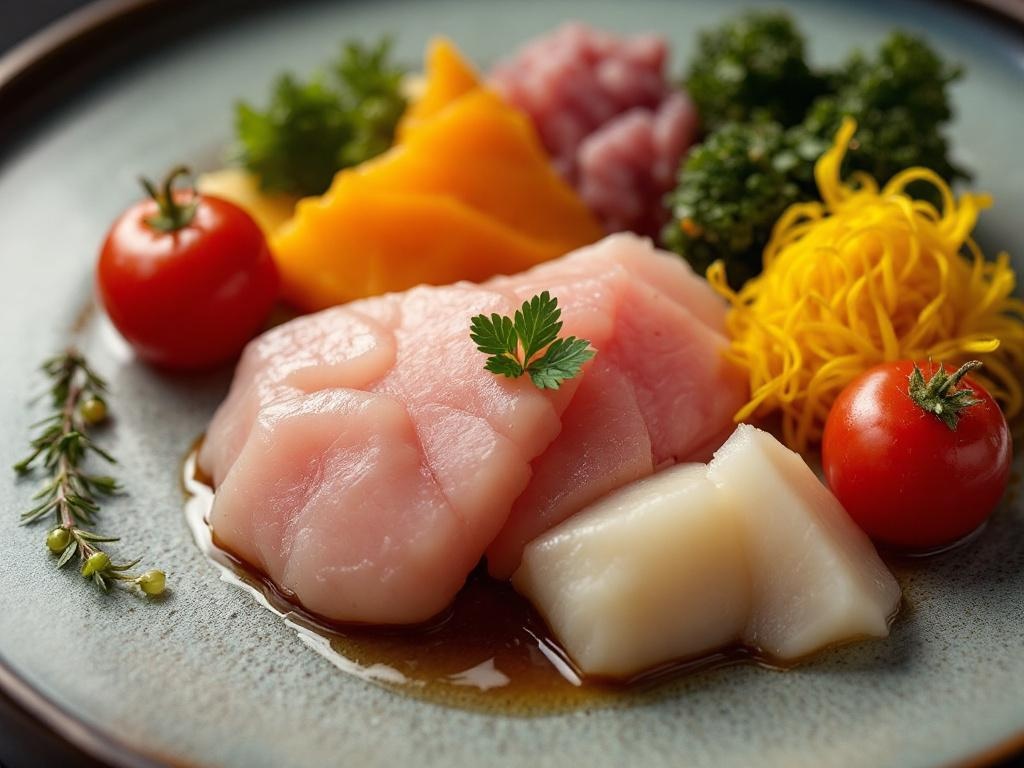
The hassun is the structural and philosophical heart of a kaiseki meal — a cedar-wood tray (hassun means 'eight sun,' approximately 24cm square) bearing a curated arrangement of seasonal small bites that sets the rhythm and theme for everything that follows. It is the course that most clearly demonstrates the kaiseki principle that food is an expression of the season, the place, and the relationship between host and guest.
The composition rules of hassun are specific. One item must come from the sea (umi no mono), one from the mountain (yama no mono), and their arrangement on the tray must reflect the season — asymmetrical, spare, never symmetrical or overly decorative. The items should contrast in texture, temperature, and form, and the tray itself — plain cedar, never lacquered for this course — is part of the presentation. After the host serves sake to guests from this tray, the formality relaxes slightly; hassun is also a transitional course.
What makes hassun technically demanding is that each small item must be complete in itself — properly seasoned, at the correct temperature, and visually distinct — while also working as part of the total composition. None of the items are afterthoughts. A pickled mountain vegetable placed beside a piece of grilled fish must contrast without competing. The grill marks on the fish must be clean and intentional.
The course reflects Kyoto's kaiseki philosophy of shun — eating at the precise peak of seasonal availability. A chef who serves hassun out of season, or with ingredients that do not reflect the moment, has failed regardless of technical execution. Hassun is as much about timing and sourcing as it is about cooking.
‹Swipe for the next dish›
IThe Market List
The benchmark for each ingredient, and who stocks it near you. Tap a stockist to go straight to the product.
Note: The Hassun course comprises 8–10 small seasonal items
typically: 2 items from mountains (sansai), 2 from sea (kaisou/kaibotsu), 2 pickled or fermented (tsukemono), 1–2 fresh items (nama-mono), 1 grilled or boiled item (yakimono/nimono).
Not yet stocked in British Columbia
Examples for spring assembly
60g
grilled matsutake mushroom
with light glaze
Your own market
80g
simmered bamboo shoot (takenoko)
with dashi and mirin
40g
pickled Japanese horseradish (wasabi-zuke)
Not yet stocked in British Columbia
50g
sashimi-grade tuna (maguro)
thin slice
Your own market
40g
uni (sea urchin) on nori
Not yet stocked in British Columbia
30g
takuan (pickled daikon radish)
sliced thin
20g
miso-marinated herring roe (kazunoko)
Not yet stocked in British Columbia
40g
grilled freshwater eel (unagi)
brushed with tare
Not yet stocked in British Columbia
Asian pear or bamboo leaves
for platter bed
Not yet stocked in British Columbia
Salt, citrus, and soy reduction
for finishing
Not yet stocked in British Columbia
Each tap is counted, so the stockist sees the demand Provenance sends them.
II
The Method
1
Arrange a base of bamboo leaves or fresh pear slices on a rectangular ceramic or wooden Hassun platter (approx. 20cm × 20cm).
2
Grill matsutake mushroom slices over charcoal or high heat for 1 minute per side; brush with a glaze of equal parts dashi, mirin, and soy sauce; season lightly with salt.
3
Simmer diced bamboo shoot in a light dashi broth (3:1 ratio) with 1 tsp mirin for 5 minutes; cool and arrange on platter.
4
Slice sashimi-grade tuna thinly (2–3mm) and arrange in a small pile; place uni on a nori rectangle alongside.
5
Arrange takuan pickles and kazunoko (herring roe in miso) in separate sections, maintaining visual balance and colour contrast.
6
Grill unagi (freshwater eel) over charcoal for 1 minute per side; brush with tare glaze (equal parts soy sauce, mirin, sake, and water, reduced); cut into 5cm lengths.
7
Arrange all components on the platter following the seasonal principle: items should represent the current season and be positioned according to the five colours (red, white, yellow, black, green) for visual harmony.
8
Serve at room temperature with small ceramic dishes of salt and citrus (sudachi or yuzu) on the side for individual seasoning.
IV
Sensory Tests
◇Sight. Cedar tray stays clean and plain — no sauce spillage onto the wood; asymmetrical arrangement of contrasting textures, temperatures, and forms speaks immediately.
◇Where it lives or dies. One item from sea, one from mountain, both at peak season, or the duality that defines hassun collapses.
VI · What to Pour
Contrasting seasonal bites — sea and mountain, warm and cool, savoury and sweet — composed as a unified seasonal statement
VII · Origin & Lineage
Kyoto, Japan — formalised within the kaiseki tradition of tea ceremony hospitality from the Azuchi-Momoyama period (16th century); systematised by later kaiseki masters
Pillars V — VII
The full recipe pages are part of membership.
Cross-cuisine parallels, what to pour, and the dish's origin and lineage — on every recipe.
Enter · from $49 a year