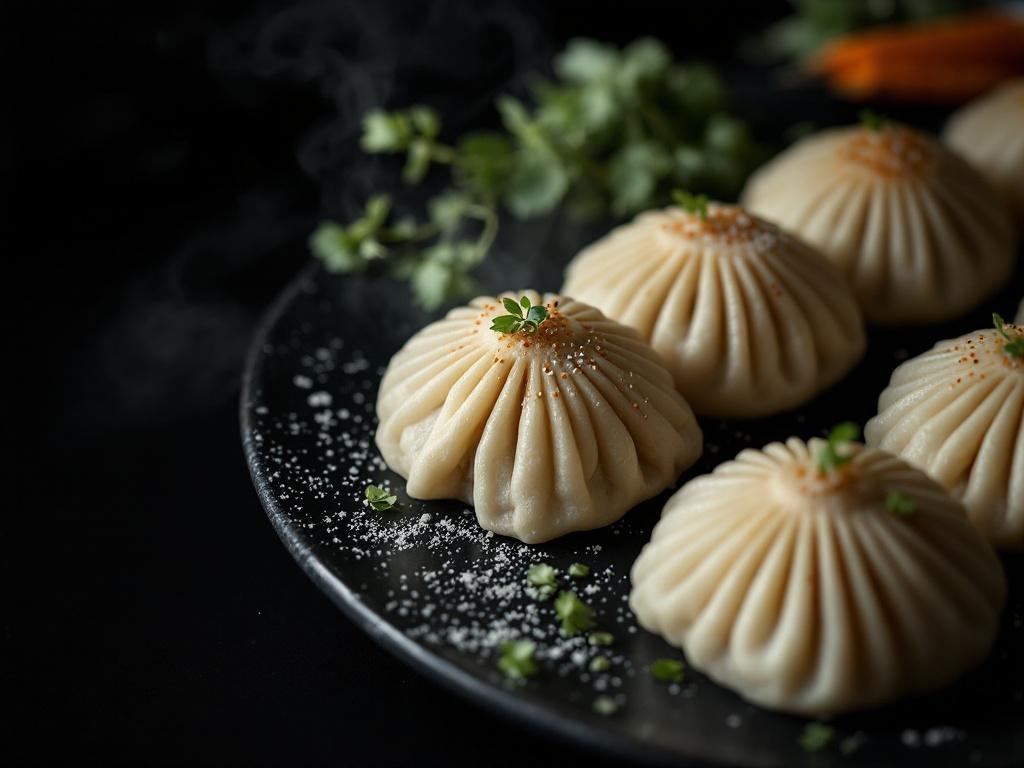
Kakuni manju is the marriage of two great traditions in southern Japanese cooking: kakuni (the slow-braised soy-mirin pork belly described separately) and manju (the steamed bun tradition that arrived from China and became a vehicle for sweet and savoury fillings across Japan). In its savoury form, kakuni manju is specifically associated with Nagasaki's shippoku cuisine and the broader Kyushu region, where the combination of Chinese bun technique and Japanese-Chinese braised pork creates a dish that is emblematic of the southern ports' hybrid culinary identity.
The bun itself is made from a yeast-leavened or baking-powder-leavened flour dough — lighter than Chinese baozi dough, with a slightly thinner skin that steams to a soft, pillowy texture without the dense chew of thicker buns. The dough is formed into rounds approximately 8-10cm in diameter, filled with a single slice of kakuni plus a small dab of Japanese mustard (karashi), then gathered and pleated at the top and placed pleat-side down for steaming. The fold is hidden beneath, producing a smooth dome when served.
The filling presents specific challenges. Kakuni is slippery and gelatinous when warm — the collagen that makes it perfect in the pot makes it difficult to handle. The slice must be taken from a cold kakuni, placed on the centred dough, and sealed before the warmth from the hands melts the fat and makes sealing difficult. Some preparations wrap the kakuni in a thin blanched cabbage leaf before placing in the bun to manage this.
Steaming is the final technique. The filled buns are proofed briefly (10-15 minutes), then steamed over boiling water for exactly 12-15 minutes — enough for the dough to cook through and expand fully, not so long that it becomes gummy or collapses. The texture should be springy when tapped gently on the dome.
‹Swipe for the next dish›
IThe Market List
The benchmark for each ingredient, and who stocks it near you. Tap a stockist to go straight to the product.
For filling
600 g
pork belly (skin-on)
cut into 3 cm cubes, blanched 5 minutes, drained
Your own market
150 ml
soy sauce (Kikkoman or equivalent)
100 ml
dashi (kombu and bonito stock)
Not yet stocked in British Columbia
20 ml
mirin
Not yet stocked in British Columbia
3 slices
ginger (peeled
1 cm thick)
2 cloves
garlic (lightly crushed)
Your own market
1
dried red chilli
Not yet stocked in British Columbia
For dough
200 g
all-purpose flour
Your own market
100 g
cake flour
Your own market
8 g
baking powder
Your own market
1
egg (room temperature)
Your own market
80 ml
whole milk
Your own market
20 ml
vegetable oil
Your own market
Each tap is counted, so the stockist sees the demand Provenance sends them.
II
The Method
1
Braise pork belly cubes in soy sauce, dashi, rock sugar, mirin, ginger, garlic, and chilli over low heat for 50 minutes until meat is fork-tender; cool and shred finely with a fork; reserve 60 ml braising liquid.
2
Whisk all-purpose flour, cake flour, sugar, and baking powder in a large bowl; create a well in center.
3
Whisk egg, milk, and vegetable oil together; pour into well and fold gently until soft dough forms — do not overwork.
4
Divide dough into 8 equal balls; flatten each into a 10 cm disc, place 25 g shredded pork and 1 tsp braising liquid in center, fold edges up and seal by pleating.
5
Place each manju seam-side down on a 10 cm square of parchment; arrange on a steamer rack over boiling water.
6
Steam covered for 12–15 minutes until dough is set and springs back when lightly pressed.
7
Remove from steamer and cool 3 minutes; serve warm, seam-side up, with remaining braising liquid drizzled over each.
IV
Sensory Tests
◇Sight. Cold kakuni holds its gelatinous seal; warm filling melts through the seam before steam sets the dough.
◇Where it lives or dies. Cold kakuni holds its gelatinous seal; warm filling melts through the seam before steam sets the dough.
VI · What to Pour
Pillowy steamed dough encasing trembling soy-braised pork belly with karashi mustard bite — rich, savoury, and deeply satisfying
VII · Origin & Lineage
Nagasaki, Japan — shippoku cuisine tradition; rooted in the Chinese baozi technique adapted through Nagasaki's Chinese trading community during the Edo period; specifically associated with southern Kyushu's hybrid food culture
Pillars V — VII
The full recipe pages are part of membership.
Cross-cuisine parallels, what to pour, and the dish's origin and lineage — on every recipe.
Enter · from $49 a year