PProvenance
Enter
Cooking in
Japan
Choose a town
Massaman Curry
Thai · Southern Thailand

Massaman Curry

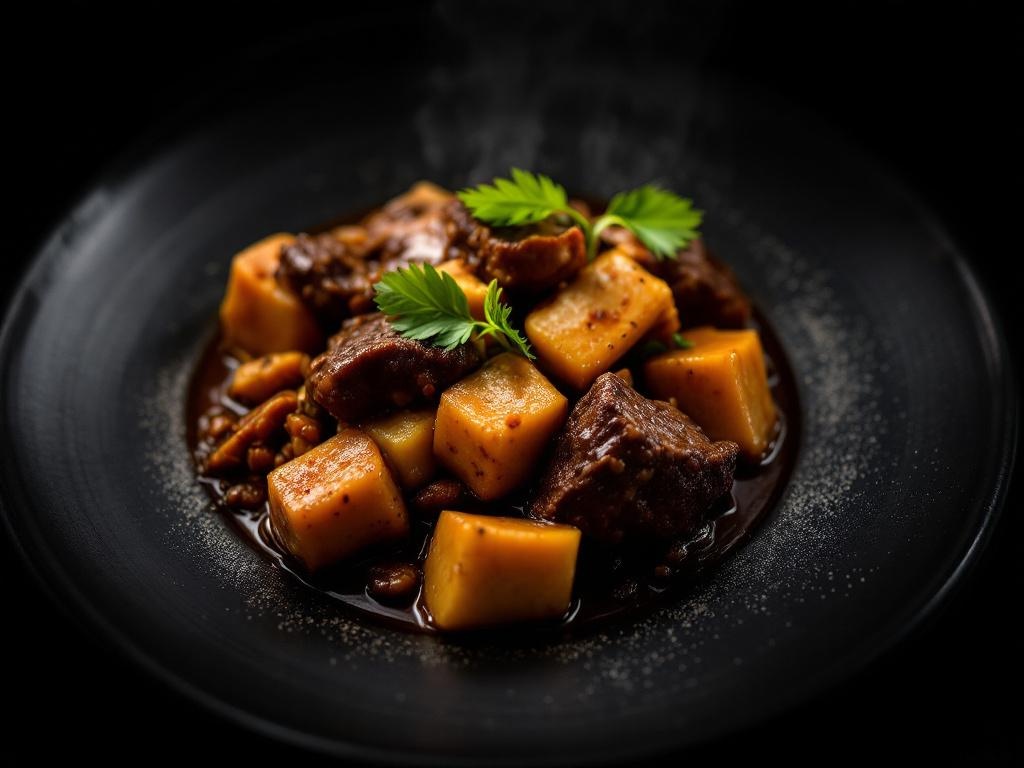
Massaman curry is Thailand's richest, mildest curry — deeply influenced by Muslim traders from the Middle East and India who brought warming spices to the southern Thai coast. Whole spices (cardamom, cinnamon, star anise, cloves) join the standard Thai aromatics in the paste. Slow-cooked beef, waxy potatoes, and peanuts make this the most substantial of the Thai curries, closer to an Indian korma in character than a Thai kaeng.

‹Swipe for the next dish›
Serves4
Total45 min
Sourced0of 10 in JP
Cook
I

The Market List

The benchmark for each ingredient, and who stocks it near you. Tap a stockist to go straight to the product.

600 g
beef chuck
cut 2 cm cubes
Your own market
400 ml
coconut milk
full-fat
Origin · Sri Lankan coconut (Coconut Research Institute of Sri Lanka), Sri Lanka
50 ml
massaman curry paste
store-bought or house-made
100 g
yellow potatoes
cut 3 cm chunks
Origin · France
75 g
roasted unsalted peanuts
Your own market
2 tablespoons
tamarind paste
2 tablespoons
fish sauce
nam pla
Your own market
15 ml
palm sugar
Origin · Indonesia
3
bay leaves
6
cardamom pods
bruised
Your own market
1
cinnamon stick
5 cm length
4 cloves
— whole
2 tablespoons
vegetable oil
Salt and Tellicherry black pepper
to taste
Your own market
Cilantro
for garnish
II

The Method

1
Heat oil in heavy-bottomed pot over medium-high heat; add massaman paste and toast 2 minutes, stirring constantly, until fragrant.
2
Add beef cubes; sear on all sides without stirring, 5 minutes total, until browned.
3
Pour in coconut milk; add bay leaves, cardamom, cinnamon, and cloves; bring to simmer.
From the canon — Fresh coconut milk — extracted from freshly grated coconut flesh rather than purchased in a can — and the technique of 'cracking' it: heating the thick, fat-… Coconut Milk: Cracking, Frying, Reducing →
4
Reduce heat to low; cover and braise 25 minutes until beef is fork-tender.
5
Add potatoes; simmer uncovered 10 minutes until potatoes begin to soften.
6
Stir in peanuts, tamarind paste, fish sauce, and palm sugar; simmer 5 minutes to marry flavors.
From the canon — Fish sauce — nam pla — is the universal salt of the Thai kitchen. Fish Sauce (Nam Pla): Selection and Use →
7
Season with salt and pepper; remove whole spices if desired.
8
Transfer to serving bowl; garnish with cilantro; serve with steamed jasmine rice.
From the canon — Thai jasmine rice — khao hom mali (fragrant jasmine rice) — cooked by the absorption method: precisely measured rice washed to remove surface starch, combine… Jasmine Rice (Khao Hom Mali): The Absorption Method →
III

Sensory Tests

◇Where it lives or dies. The moment where Massaman lives or dies is the same-day versus next-day decision. Massaman improves dramatically when reheated the following day — the spices deepen, the coconut milk becomes more integrated, and the beef absorbs more of the sauce. If time allows, make Massaman the day before.
IV

Cross-Cuisine Parallels

Indian korma (mild, spiced, coconut cream-based
the direct ancestor from the Persian-Mughal tradition)
Malay rendang (long-cooked dry coconut beef
the Malay parallel)
Moroccan beef tagine with warming spices
(similar warming-spice profile in a North African context).
V

What to Pour

Pouring for Japan ·

The pairing
1897 Amber Ale
Stanley Park Brewing · Metro Vancouver
Cut — the bead (a fine, persistent bead) scrubs the salt and savour between bites; the palate arrives clean at every pass.
Not yet stocked in Japan
Beer
From Japan

Nothing from Japan holds against this yet.

Without alcohol
Leitz Eins Zwei Zero Riesling
Weingut Leitz · Rheingau
Cut — the acidity ('citrus') scrubs the salt and savour between bites; the palate arrives clean at every pass.
Not yet stocked in Japan
Non-alcoholic
The whole pairing
VI

Origin & Lineage

Southern Thailand, with strong Muslim Malay and Persian-Indian influence. The name is thought to derive from Mussulman (Muslim) or from the Persian word musaman. The dish reflects the spice trade routes that brought cardamom, cinnamon, and star anise through the Strait of Malacca to the Thai peninsula.