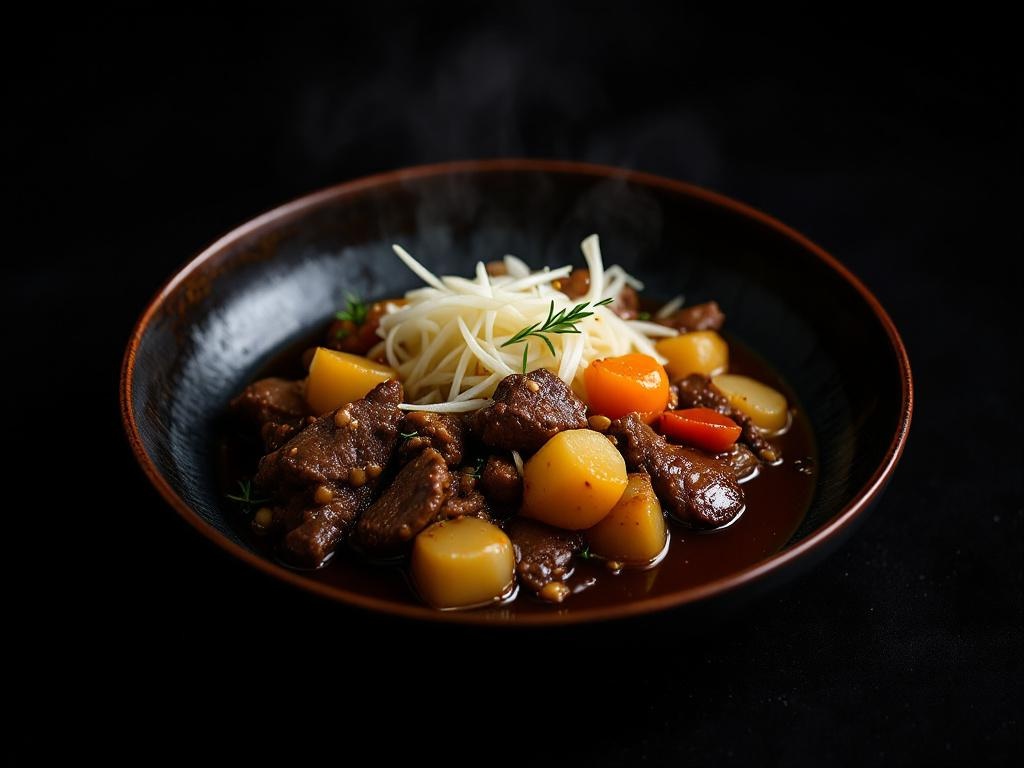
Nikujaga — literally 'meat and potatoes' — is Japan's most unapologetically comforting dish, a soy-mirin-dashi braise of beef, potato, and onion that occupies the same emotional territory as beef stew or pot-au-feu in Western cooking. Its origin story is contested but beloved: naval officer Tōgō Heihachirō reportedly requested a beef stew after tasting it in England, and naval cooks in Maizuru or Kure (both claim the birthright) adapted it using Japanese pantry staples.
The dish is fundamentally about the interaction between the sweet-savoury braising liquid and the potato. The broth — dashi, soy, mirin, and a touch of sugar — must reduce into the potato as it cooks, so the potato absorbs the entire flavour profile rather than just being poached in it. The beef, traditionally thinly sliced shabu-shabu style rather than cubed, needs only minimal cooking; it is added near the end or layered over the vegetables so it stays tender and imparts fat into the broth.
Regional variation is significant. Kansai-area versions use thinly sliced beef and tend sweeter; Kantō versions use pork and skew saltier. The vegetable lineup often includes shirataki noodles and green peas, added for texture and colour contrast.
Nikujaga is a dish that rewards simplicity. The temptation to over-season or rush the simmer ruins it. A proper nikujaga is cooked with a drop lid (otoshibuta) — a wooden or foil circle placed directly on the ingredients inside the pot — which circulates the braising liquid evenly without requiring stirring and prevents the potato from breaking apart from agitation.
‹Swipe for the next dish›
IThe Market List
The benchmark for each ingredient, and who stocks it near you. Tap a stockist to go straight to the product.
600g
beef chuck
cut into 3cm cubes
Your own market
300g
waxy potato (Danshaku or similar)
cut into 2cm cubes
200g
onion
cut into 1cm wedges
Your own market
30g
vegetable oil
Your own market
50ml
mirin
hon-mirin
Not yet stocked in British Columbia
400ml
dashi (kombu and bonito stock)
Not yet stocked in British Columbia
1 tbsp
sake
premium grade
Not yet stocked in British Columbia
Water as needed
Not yet stocked in British Columbia
Scallion
sliced thin, for garnish
Not yet stocked in British Columbia
Each tap is counted, so the stockist sees the demand Provenance sends them.
II
The Method
1
Heat vegetable oil in a large heavy-bottomed pot over medium-high heat; add beef cubes and sear on all sides until deeply browned (6–8 minutes); do not crowd the pan; transfer to a plate.
2
Add onion wedges to the pot and sauté until translucent and lightly caramelized (3–4 minutes); return beef to pot.
3
Pour dashi and sake over beef; add mirin, soy sauce, and sugar; stir gently to combine; bring to a simmer over medium heat, skimming any scum that rises to the surface.
4
Cover and simmer gently for 20 minutes until beef is tender; add potato cubes and continue simmering uncovered for 12–15 minutes until potatoes are tender and liquid has reduced by one-third.
5
Taste and adjust seasoning with additional soy sauce or sugar if needed (the broth should be savory and slightly sweet with a glossy appearance from reduced gelatin).
6
Divide into bowls and garnish with sliced scallion; serve hot with white steamed rice on the side.
IV
Sensory Tests
◇Sight. Caramel-edged reduction clinging to potato — broth has collapsed from liquid to glaze, soy and mirin darkened at the pan edges.
◇Where it lives or dies. Caramel-edged reduction clinging to potato — broth has collapsed from liquid to glaze, soy and mirin darkened at the pan edges.
VI · What to Pour
Sweet-savoury soy-mirin depth absorbed into potato, with tender beef and an umami-rich reduced broth
VII · Origin & Lineage
Maizuru or Kure, Japan — late Meiji era (1890s), associated with naval cooking and the adaptation of Western stew to Japanese pantry ingredients
Pillars V — VII
The full recipe pages are part of membership.
Cross-cuisine parallels, what to pour, and the dish's origin and lineage — on every recipe.
Enter · from $49 a year