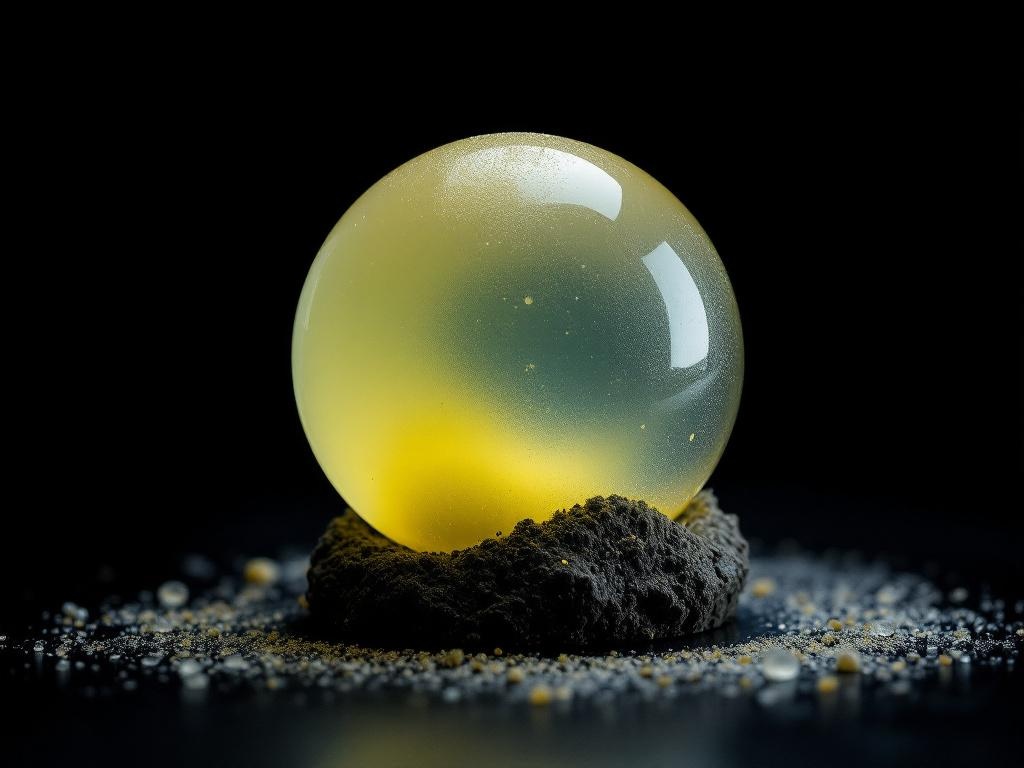
Reverse Spherification (Calcium Lactate Shell Method)
Reverse spherification inverts the reagent positions of basic spherification to overcome its key limitations: short shelf life and incompatibility with calcium-rich or highly acidic liquids. In reverse spherification, calcium lactate (or calcium lactate gluconate for clearer results) is dissolved into the flavoured base, and sodium alginate is dissolved into the setting bath. When the calcium-laden base contacts the alginate bath, gelation proceeds from the outside inward, forming a membrane that does not continue to thicken once the sphere is removed. This outside-in gelation means the sphere stabilises quickly and then stops — reverse spheres can be made hours or even a day in advance and held in flavoured water without degradation. The interior remains perfectly liquid indefinitely. This shelf stability makes reverse spherification the professional default in fine dining kitchens where advance preparation is essential to service flow. Calcium lactate is used at approximately 2–3% in the base. Calcium lactate gluconate (a blended salt) is preferred when the base requires crystal clarity because it has no chalky bitterness. The alginate bath is prepared at 0.5–0.6% — higher than basic spherification — and must rest for several hours to fully hydrate and become bubble-free. The bath must be made fresh daily as it degrades. Because calcium is in the base, dairy products, stocks, and purées can all be spherified without premature gelling. The technique is ideal for yoghurt spheres, olive oil globes, mango 'yolks', and even spirits-based caviar pearls. The outer membrane is slightly thicker than basic spherification but still has a satisfying pop. Temperature plays an important role: the base should be at room temperature or slightly warm for optimal sphere formation, while the bath should be kept between 18–22°C.
The Market List
The benchmark for each ingredient, and who stocks it near you. Tap a stockist to go straight to the product.
The Method
Sensory Tests
What to Pour
Origin & Lineage
Refined by the elBulli team and culinary modernists in the mid-2000s as a practical evolution of basic spherification for professional kitchen use