North African / Levantine
Shakshuka
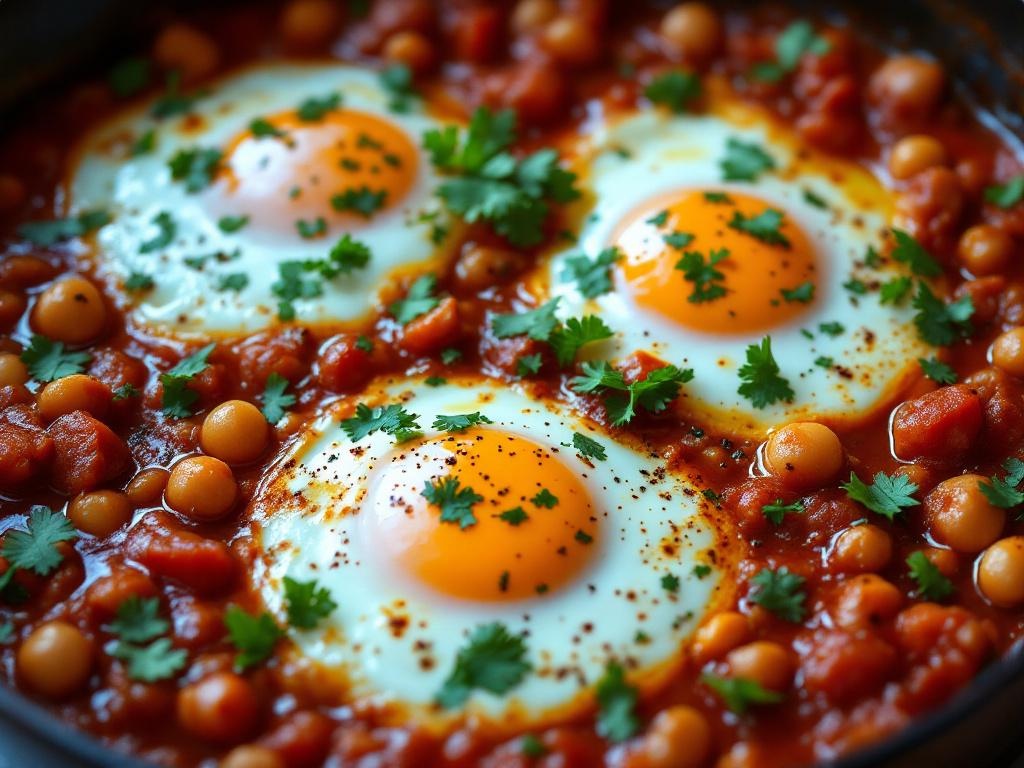
Eggs poached in a spiced tomato base. The whites set. The yolks tremble. The debate over ownership — Tunisia, Israel, Libya, Palestine — has never been resolved. The dish does not require resolution to be excellent.
‹Swipe for the next dish›
I
The Market List
The benchmark for each ingredient, and who stocks it near you. Tap a stockist to go straight to the product.
6
eggs
free-range — the centrepiece
Your own market
800 g
2
red bell peppers
deseeded, thinly sliced
Your own market
1 large
yellow onion
thinly sliced
Your own market
5 cloves
garlic
thinly sliced — not minced
Your own market
1.5 tsp
cumin seeds
whole, toasted in the pan
Not yet stocked in British Columbia
1.5 tsp
sweet smoked paprika
Not yet stocked in British Columbia
1 tsp
Aleppo pepper (pul biber)
or harissa for more heat
Not yet stocked in British Columbia
4 tbsp
extra virgin olive oil
Your own market
100 g
feta cheese
crumbled — optional but classical Levantine addition
Not yet stocked in British Columbia
handful
flat-leaf parsley
roughly chopped
Your own market
to serve
crusty bread
laffa, pita, or sourdough
Your own market
Each tap is counted, so the stockist sees the demand Provenance sends them.
II
The Method
1
Toast cumin seeds in olive oil over medium heat until fragrant, 30 seconds. Add sliced onion with a pinch of salt, cook 8–10 minutes until softened and beginning to colour.
Toasting whole spices in oil before adding other ingredients is called tarka or tempering. The heat activates and volatilises the essential oils in the spice, which infuse into the fat. Oil-soluble flavour compounds dissolve into the fat and distribute throughout the dish as it cooks. Adding whole spices to cold or wet ingredients significantly reduces their aromatic impact.
2
Add sliced peppers, cook 5 minutes until wilted. Add garlic, paprika, and Aleppo pepper, stir 1 minute.
The sliced (not minced) garlic technique prevents burning — thin slices cook evenly and soften before charring. Minced garlic has higher surface area and can burn in under 30 seconds. Aleppo pepper is added dry to the oil before the tomatoes because its fat-soluble colour compounds (capsanthin, capsorubin) need fat to bloom fully — this is why well-made shakshuka achieves a deep, saturated red-orange that cannot be replicated by adding spices to water.
3
Crush tomatoes by hand directly into the pan. Season with salt. Simmer uncovered 15 minutes until thick and the oil separates around the edges.
The hand-crush technique produces irregular texture — some pieces almost liquid, some larger — creating pockets of concentrated tomato that vary the eating experience. The oil-separation indicator is the North African equivalent of the Indian bhunao: the water has fully evaporated, the sauce has concentrated, and the oil is visible again around the periphery. This is the moment the base is ready for the eggs.
4
Make 6 wells in the sauce with the back of a spoon. Crack one egg into each well. Season the eggs.
Wells that are made with a decisive press hold their shape. Hesitant wells fill back in immediately. For intact yolks, crack each egg into a ramekin first and then slide into the well — dropping from height risks breaking the yolk on contact with the sauce. The well should be deep enough that the egg sits partially submerged — this cooks the white from below while steam from the sauce cooks it from above.
5
Cover the pan, reduce heat to low, cook 5–8 minutes. Whites should be just set, yolks still runny. Do not overcook.
The covering technique uses steam from the hot sauce to set the whites from above while the sauce heat sets them from below — a gentler, more even cooking method than direct heat alone. The critical visual cue is when the white transitions from transparent to opaque right around the yolk — this is the moment to remove from heat. The yolk continues cooking for 60–90 seconds after the pan is removed from heat.
6
Remove from heat. Scatter crumbled feta and parsley. Bring the pan to the table. Serve immediately with bread.
Shakshuka is a pan-to-table dish. Transferring to plates breaks yolks and loses the visual impact. The presentation — golden yolks in red sauce, white feta, green parsley — is a considered composition that also happens to show doneness. Bread is not a side; it is the eating implement. The ideal bite combines pierced yolk, sauce, a piece of fish, a crumb of feta, and a leaf of parsley.
III
Quality Hierarchy
01
San Marzano DOP canned tomatoes in winter, ripe fresh tomatoes in summer — the difference is measurable, not subjective.
02
Harissa, Tunisian-style or rose harissa — more complex than cayenne or chilli flakes alone.
03
Eggs at room temperature — cold eggs crack the surface tension of the hot sauce.
04
Cumin seeds bloomed in oil before any other addition — the foundation of the flavour.
05
Feta or labneh at serving — the dairy cuts the acid sharpness and completes the dish.
IV
Sensory Tests
◇When the lid is lifted, whites should be matt opaque; yolks should still be domed, not flat.
◇A gentle shake of the pan should move the yolks but not the whites.
◇The sauce should bubble at the edges only — not in the centre where the eggs sit.
◇Where it lives or dies. The moment the lid comes off: egg whites should be matt and opaque, yolks still domed and liquid. A yolk that has set hard is a failure of timing. A white that is still translucent is a failure of patience. The window between them is approximately 90 seconds.
Pillars V — VII
The full recipe pages are part of membership.
Cross-cuisine parallels, what to pour, and the dish's origin and lineage — on every recipe.
Enter · from $49 a year