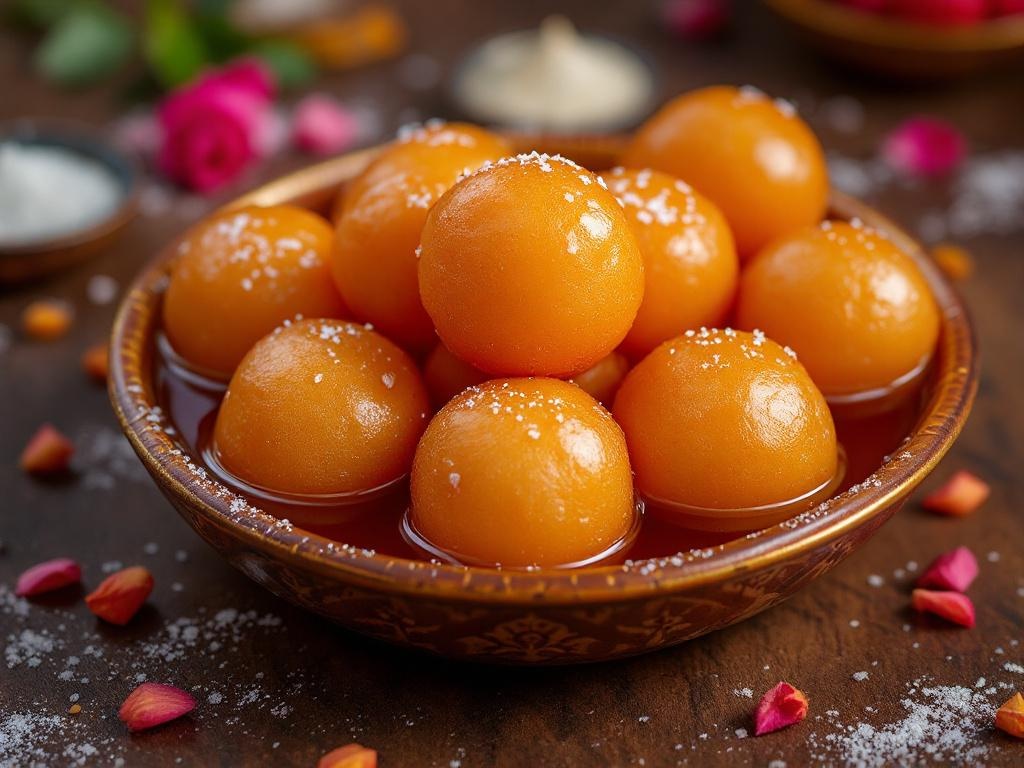
Diwali Gulab Jamun
Gulab jamun — soft, spongy milk-solid balls soaked in rose-scented sugar syrup — are among the most beloved sweets across South Asia and are central to Diwali celebrations, as well as every other occasion of significance. The name translates as 'rose water' (gulab) and 'berry' (jamun), referring to the rose-flavoured syrup and the berry-like size and colour. The balls are made from khoya (reduced milk solids) or milk powder, mixed with a small amount of flour and cardamom, shaped into smooth balls, and deep-fried at a precise low temperature until evenly golden — then plunged into the warm sugar syrup while hot, which allows them to absorb it fully. The absorbed syrup is what creates the characteristic softness; gulab jamun that haven't absorbed enough syrup are dense and dry. Patience during frying (low heat throughout, 12–15 minutes per batch) and adequate soaking time (minimum 30 minutes, ideally longer) are the two non-negotiable elements.
Four in town · six elsewhere in British Columbia · two not yet within reach.
- In town
- 4 · all-purpose flour, evaporated milk, whole milk, sugar
- Elsewhere in British Columbia
- 6 · ghee, green cardamom pod, saffron threads, vegetable oil for deep-frying, rose water, pistachios
- Not yet within reach
- 2 · whole milk powder, green cardamom pods
The Market List
The benchmark for each ingredient, and who stocks it near you. Tap a stockist to go straight to the product.
Within reach counts in town, delivered, shipped and the nearest city. A staple counts once it has a local seller. Charted from each shop's own pages; not yet vouched by a cook who shops here.
The larder of Nanaimo →Each tap is counted, so the stockist sees the demand Provenance sends them.
The Method
Sensory Tests
What to Pour
Each tap is counted, so the stockist sees the demand Provenance sends them.
The whole pairingOrigin & Lineage
Indian subcontinent; gulab jamun's origins trace to Persia (similar preparations like luqmat al-qadi) brought to India during the Mughal period c. 16th–17th century; now iconic across India, Pakistan, Bangladesh, and the diaspora.