PProvenance
Enter
Bengali Shorshe Ilish (Hilsa in Mustard Paste — Steam Method)
Indian · Bengal

Bengali Shorshe Ilish (Hilsa in Mustard Paste — Steam Method)

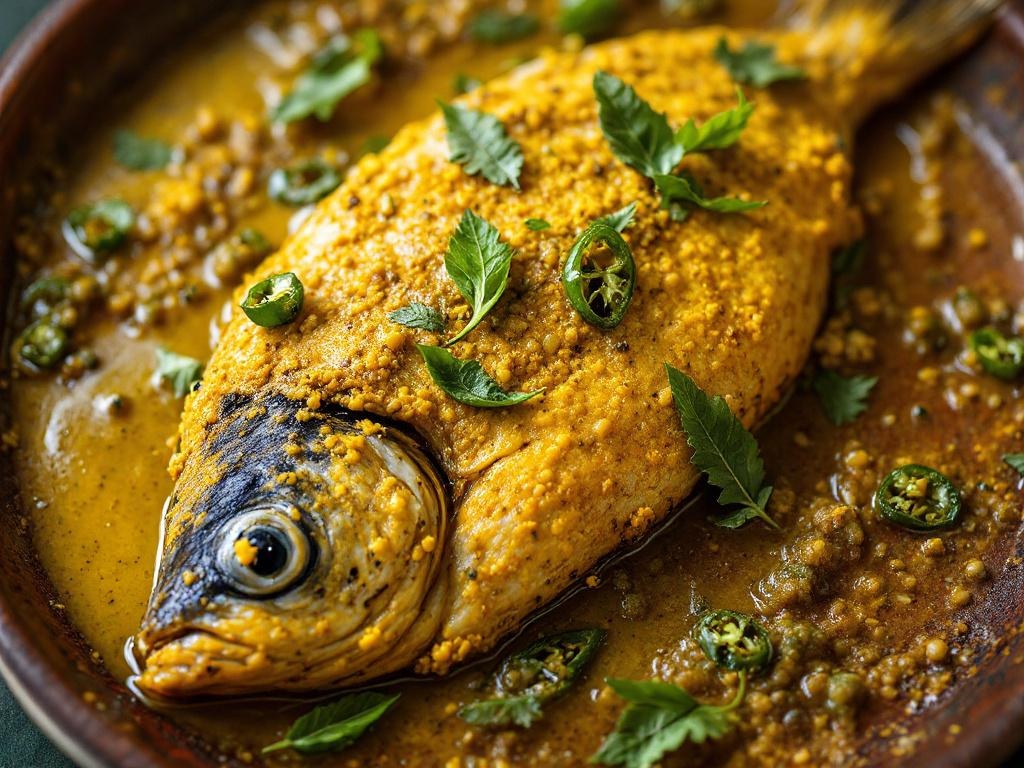
Shorshe ilish — hilsa (ilish) fish steamed or gently cooked in freshly ground mustard paste — is the most celebrated dish in Bengali cuisine and a preparation of enormous cultural weight. The hilsa (Tenualosa ilisha) is to Bengal what sablefish is to the Pacific Northwest — a seasonally available, regionally specific fish of extraordinary fat content and flavour complexity, whose arrival in the summer monsoon season is anticipated with genuine cultural excitement. Shorshe ilish represents Bengali cooking at its most confident: minimal ingredients, premium fish, and a technique that reveals rather than transforms. The mustard paste is the critical technical component. Bengali cooks traditionally grind mustard seeds with green chilli, salt, and a small amount of turmeric on a grinding stone (shil nora) to produce a paste that retains some textural coarseness — not the smooth prepared mustard of the West. Black mustard seeds (rai) produce a more pungent, bitter paste; yellow mustard (shorshe) produces a milder, slightly sweet base. Most Bengali households blend both. The proportional ratio is jealously guarded family knowledge. The cooking technique is one of the simplest in Indian cuisine but requires the most precision. Hilsa steaks (with bone — the bones and skin contribute essential fat to the sauce) are coated in the mustard paste mixed with mustard oil and green chilli, placed in a flat-bottomed vessel, and either steamed over simmering water or cooked at very low heat with just a small amount of water — a technique called bhape (steam). The fish must cook in its own fat and the mustard coating — no additional liquid, no extended cooking time. The hilsa's natural oil content is the sauce. Overcooking hilsa is the primary failure — the fish needs 8–12 minutes; a minute too many and the delicate fat structure breaks down, producing a dry, grainy result. The finished dish should have fish flesh that pulls from the bone in silky flakes, surrounded by a yellow-green mustard paste that has set to a concentrated coating.

‹Swipe for the next dish›
Serves4
Total45 min
Sourced1of 13 in BC
Cook
I

The Market List

The benchmark for each ingredient, and who stocks it near you. Tap a stockist to go straight to the product.

1
whole hilsa fish (ilish)
600-700g, scaled and gutted, cut in half lengthwise or left whole
Your own market
60ml
mustard oil
Not yet stocked in British Columbia
3 tablespoons
whole brown mustard seeds (rai)
Your own market
20g
fresh ginger
minced
2
green chillies
minced
Not yet stocked in British Columbia
1
dried red chilli
deseeded
Not yet stocked in British Columbia
200g
plain yogurt
Your own market
4g
salt
Your own market
2g
sugar
Your own market
1g
turmeric powder
Not yet stocked in British Columbia
2g
black pepper
freshly ground
Your own market
10ml
fresh lemon juice
Not yet stocked in British Columbia
1
banana leaf
25×25cm, or parchment paper for steaming
Not yet stocked in British Columbia

Each tap is counted, so the stockist sees the demand Provenance sends them.

II

The Method

1
Soak 3 tablespoons brown mustard seeds in 40ml room-temperature water for 5 minutes to soften; grind to smooth, thick paste using mortar and pestle or wet grinder — paste should be thick, grainy, and bright yellow.
2
In bowl, combine mustard paste, 200g yogurt, minced ginger, green chillies, deseeded dried red chilli, salt, sugar, turmeric, and black pepper; whisk until uniform sauce forms — it should be thick, pourable, and pungent.
From the canon — Turmeric (हल्दी, haldi — Curcuma longa) is the most universally used spice in Indian cooking: the yellow-orange rhizome whose primary active compound (curcum… Turmeric — Fresh vs Dried in Indian Cooking (हल्दी) →
3
Pat fish pieces dry; lay on work surface; brush both sides generously with mustard-yogurt mixture, working sauce into skin and crevices; if using whole fish, stuff cavity with some sauce as well.
4
Prepare banana leaf (or parchment) by lightly wiping with damp cloth to make pliable; lay on work surface; place mustard-coated fish in centre; fold leaf around fish to create sealed parcel, securing with toothpick if needed.
5
Set up bamboo or metal steamer basket over pot with 5cm simmering water; place sealed fish parcel on steaming platform.
6
Cover steamer tightly with its lid, steam for 18 minutes if fish is halved, or 24 minutes if whole — fish flesh should be opaque, cooked through, and just tender; mustard sauce should have thickened and adhered to flesh.
7
Carefully remove steamed parcel; open leaf to release trapped steam (it will be very hot); transfer fish with all cooking juices to serving platter, leaving banana leaf behind if desired.
8
Drizzle with mustard oil and lemon juice; serve immediately whilst still steaming, with steamed rice and sautéed greens — the delicate hilsa flesh and pungent mustard coating is a classic Bengali preparation; leftovers remain flavourful when eaten cold the next day.
IV

Sensory Tests

◇Sight. Watch the flesh pale from deep translucent to opaque ivory at the edges while the centre stays barely clear — that's your signal to lift the lid and kill the heat.
◇Where it lives or dies. Pull the steamer at 8–10 minutes when the hilsa is still translucent in the middle; one minute more and the fat breaks into graininess.
VI

What to Pour

Pouring for British Columbia ·

The pairing
Blandy's Sercial Colheita Madeira
Blandy's · Madeira
Not yet stocked in British Columbia
Fortified wine
From British Columbia
Seaside Gin
Sheringham Distillery · Vancouver Island
Liberty Wine Merchants · Vancouver →
Spirits gin
Without alcohol

No pour without alcohol holds against this yet.

Each tap is counted, so the stockist sees the demand Provenance sends them.

Why each one works is part of membership — Enter · from $49 a year →

The whole pairing
Pillar VII
Origin and lineage are part of membership.
Where the dish comes from and how it came to be — on every recipe.
Enter · from $49 a year