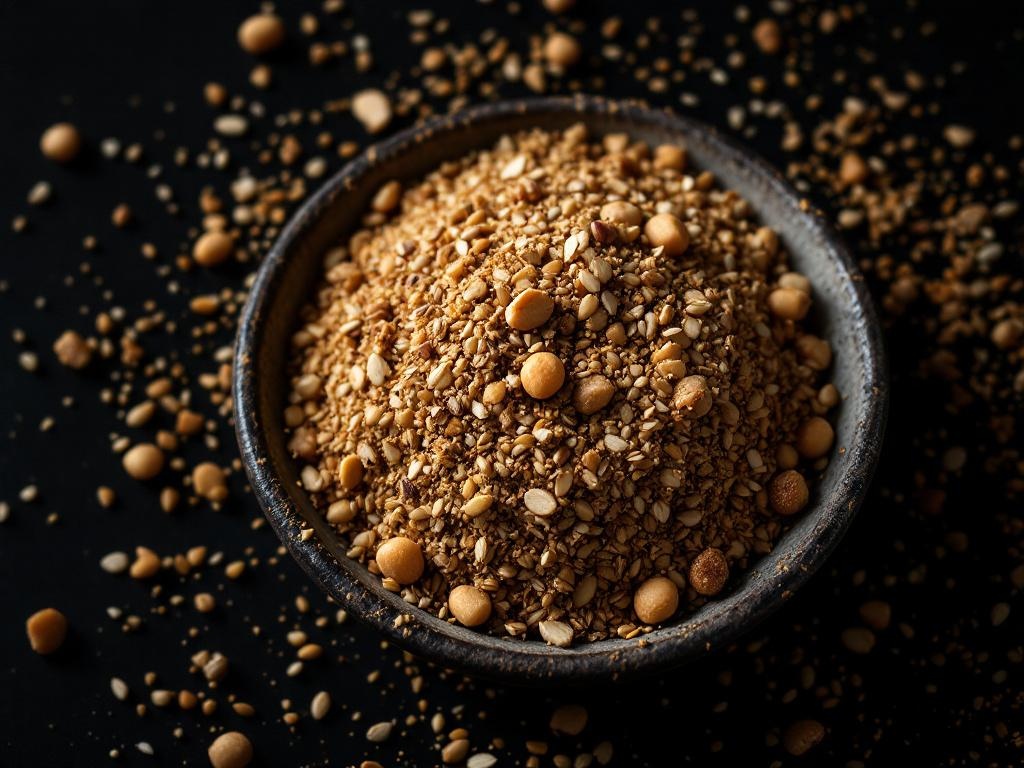
Dukkah is an Egyptian condiment of roasted nuts and spices ground to a coarse, dry crumble — one of the most versatile pantry preparations in the Middle Eastern kitchen. The name comes from the Arabic 'to pound', and the texture is always dry and crumbly rather than paste-like. It is eaten by dipping bread first into good olive oil, then into dukkah — the oil helps the dry mixture adhere.
The classic Egyptian dukkah base includes hazelnuts or chickpeas, sesame seeds, cumin, coriander, and salt, dry-roasted separately and then pounded together loosely. Modern versions expand the nut base to include almonds, pistachios, or cashews; add fennel seed, black pepper, dried thyme, or rose petals. The Egyptian village tradition uses whatever nuts and seeds are available and the result varies by household.
The texture is the defining characteristic: dukkah should have distinct pieces of crushed nut and whole toasted seeds, not a powder. This requires careful pounding — not blending, which turns it to paste — and attention to the nut-to-spice ratio. Too many spices relative to nuts produces something sharp and medicinal; the right balance is nutty-forward with spice as supporting complexity.
Dukkah has crossed far beyond Egypt in recent decades, appearing on restaurant bread plates globally, used as a crust for fish or lamb, stirred into yoghurt, or scattered over roasted vegetables. Its adaptability comes from the fact that its flavour is universally pleasing — roasted, nutty, warmly spiced — without belonging to any single cuisine.
‹Swipe for the next dish›
IThe Market List
The benchmark for each ingredient, and who stocks it near you. Tap a stockist to go straight to the product.
40 g
sesame seeds
unhulled
Not yet stocked in British Columbia
30 g
blanched peanuts or hazelnuts
20 g
coriander seeds
Your own market
20 g
cumin seeds
Not yet stocked in British Columbia
10 g
black peppercorns
Tellicherry
Not yet stocked in British Columbia
5 g
dried chilli flakes
Aleppo or Marash
Not yet stocked in British Columbia
5 g
fine sea salt
Your own market
Each tap is counted, so the stockist sees the demand Provenance sends them.
II
The Method
1
Toast sesame seeds in a dry skillet over medium heat for 3–4 minutes, shaking frequently, until fragrant and lightly coloured; transfer to a bowl.
2
Toast peanuts in the same skillet for 2–3 minutes until golden and aromatic; add to sesame.
3
Toast coriander seeds for 2 minutes until fragrant; transfer to bowl.
4
Toast cumin seeds for 2 minutes until fragrant; add to bowl.
5
Toast black peppercorns for 1 minute; add to bowl and allow all components to cool to room temperature.
6
Coarsely grind cooled ingredients in a mortar with a pestle or spice grinder, preserving some texture.
7
Stir in dried chilli flakes and fine sea salt; transfer to an airtight container and store in a cool, dark place for up to 3 months.
IV
Sensory Tests
◇Sight. Coarse, dry crumble that crunches between your teeth — never paste or dust. Each component roasted separately until fragrant, cooled completely before pounding.
◇Where it lives or dies. Pound rather than blend. A food processor becomes paste in seconds; use mortar or pulse 3–4 times only. The crumble texture is dukkah — lose it and you lose the dish.
VI · What to Pour
Roasted nuts, warm spices, sesame — dry and crumbly with textural contrast
VII · Origin & Lineage
Egypt — ancient spice-and-nut condiment tradition; particularly associated with the Nile Delta
Pillars V — VII
The full recipe pages are part of membership.
Cross-cuisine parallels, what to pour, and the dish's origin and lineage — on every recipe.
Enter · from $49 a year